
Introduction: When Struggles Don’t Have a Clear Label
Have you ever wondered whether your child—or you yourself—might have ADHD, a learning disability, or anxiety? Maybe there’s trouble focusing, constant frustration with homework, or a pattern of avoidance when it comes to school or work. The symptoms are real—but the cause isn’t always clear.
ADHD, learning disabilities, and anxiety are among the most commonly misunderstood and misdiagnosed conditions in both children and adults. They can look remarkably similar on the surface, and they often co-occur. But just as often, one condition is mistaken for another, leading to ineffective support or missed opportunities for help.
This blog post unpacks the key differences and overlaps between these three diagnoses and explains why a comprehensive neuropsychological evaluation is essential for figuring out what’s really going on.
Clarifying the Purpose
These three conditions—ADHD, anxiety, and learning disabilities—are among the most common concerns brought to neuropsychologists. And while they’re distinct diagnoses, they can produce similar day-to-day challenges, such as:
- Inattention or poor focus
- Low academic performance
- Avoidance of school or work
- Emotional outbursts or shutdowns
Sometimes they occur together. Other times, one condition may mimic another. For instance, a child who avoids reading might be anxious, have undiagnosed dyslexia, or struggle with attention and task initiation. Adults might procrastinate due to executive dysfunction from ADHD—or perfectionism and fear of failure rooted in anxiety.
Because ADHD, anxiety, and learning disorders can look similar on the surface, a comprehensive evaluation can help clarify what is actually driving a child’s difficulties. Depending on the referral question, families may benefit from a pediatric ADHD evaluation, pediatric anxiety evaluation, or pediatric learning disability evaluation.
Important Context: It’s Never Just One Thing
While this post highlights three commonly confused diagnoses, a high-quality neuropsychological evaluation never considers only these three options. At Chester Neuropsychology, our evaluations are grounded in a whole-person approach, which means we also explore:
- Medical Factors: Sleep problems, seizure history, past concussions, chronic illness, or genetic syndromes
- Neurodevelopmental Factors: Early speech or motor delays, autism spectrum symptoms, or coordination issues. For a deeper look at how autism is assessed across age groups, click here.
- Trauma: Childhood adversity, abuse, neglect, or complex trauma histories
- Psychosocial Stressors: Family dynamics, grief, bullying, recent life changes, poor school fit
- Cultural and Linguistic Background: Cultural values, bilingualism, or disparities in access to resources
Why This Still Matters
Despite the wide range of factors we consider during an evaluation, ADHD, anxiety, and learning disabilities are frequently confused—even by well-meaning professionals. That’s why this post zooms in on them.
Clarifying their differences—and recognizing their shared features—is an important first step toward getting the right diagnosis and support.
Quick Definitions: What Are We Really Talking About?
- ADHD (Attention-Deficit/Hyperactivity Disorder): A neurodevelopmental disorder marked by persistent challenges with attention, impulsivity, and/or hyperactivity that interfere with academic, occupational, or social functioning. If you’d like to learn more about how ADHD shows up across different ages, click here.
- Learning Disabilities: Specific difficulties in academic skills—most commonly reading (dyslexia), writing (dysgraphia), or math (dyscalculia)—despite adequate intelligence and educational opportunity.
- Anxiety: A mood condition involving excessive worry, fear, or physiological symptoms (e.g., stomachaches, racing heart) that interfere with concentration, motivation, sleep, and performance in daily life.
Common Overlapping Symptoms
All three diagnoses can look similar on the surface, especially in school-age children or under high stress. Shared symptoms may include:
- Difficulty focusing
- Trouble completing tasks
- Avoidance of school or work
- Low self-confidence
- Emotional dysregulation (e.g., meltdowns, withdrawal, frustration)
The confusion lies in the why:
- A child who avoids writing might have dysgraphia, be anxious about making mistakes, or be struggling with sustained attention.
- An adult who procrastinates might have ADHD, perfectionism, or undiagnosed reading difficulties.
- A student with frequent emotional outbursts might be overwhelmed by academic demands due to a learning disorder—or may be reacting to internal anxiety they can’t express.
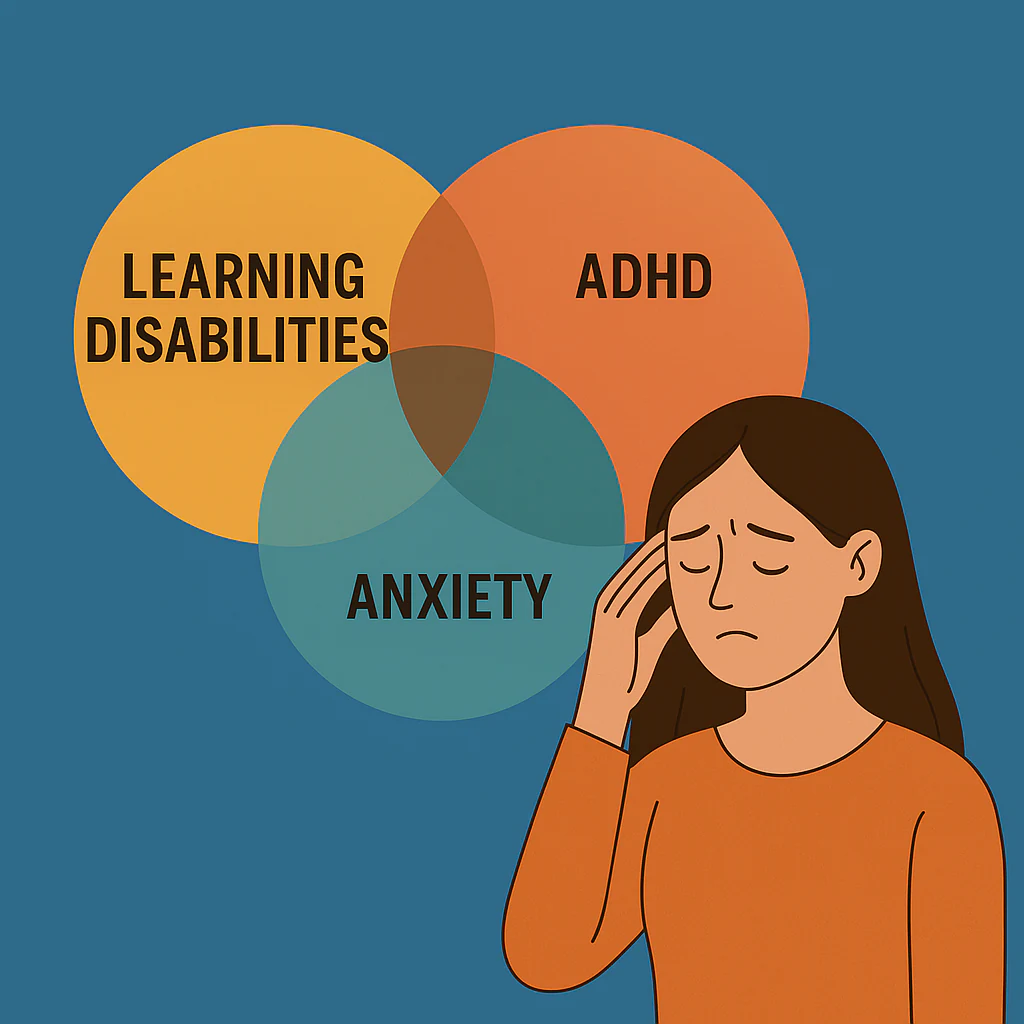
Where ADHD, Anxiety, and Learning Disabilities Overlap
ADHD-only symptoms:
- Impulsivity
- Poor working memory
- Trouble sitting still or staying organized
Anxiety-only symptoms:
- Excessive worry
- Avoidance due to fear of failure
- Physical symptoms (e.g., stomachaches, sleep issues)
LD-only symptoms:
- Poor decoding or math fact retrieval
- Spelling or handwriting difficulties
- Gaps between intelligence and performance
Overlap zone:
- Inattention
- Academic underperformance
- Task avoidance
- Frustration and emotional distress
How Misdiagnoses Happen
It’s common for these diagnoses to be confused, especially when evaluation is based on limited information. Misdiagnosis often occurs when:
- Checklists are used without deeper assessment
- Behavior is interpreted without academic testing
- Medical or developmental history is overlooked
- Medication trials are used as diagnostic tools
- Environmental or cultural factors are ignored
Example: A child with undiagnosed dyslexia may be labeled as having ADHD because they zone out during reading time. But treating them with stimulants won’t make decoding any easier—it will just make them focus better on something they still don’t understand.
How Neuropsychological Testing Clarifies the Picture
At Chester Neuropsychology, we conduct comprehensive evaluations designed to uncover not only what the challenges are—but why they are happening and how best to support them. We evaluate a wide range of neurocognitive, academic, and emotional domains to build a complete, individualized understanding of the person being assessed.
Our evaluations typically assess:
- Cognitive abilities, including IQ/intellectual functioning, problem-solving, and abstract reasoning
- Academic achievement in reading, math, and writing
- Executive functioning: planning, organization, inhibition, and working memory
- Attention regulation and task persistence
- Memory functioning: immediate, delayed, and visual memory
- Language and verbal-linguistic skills: comprehension, expression, word retrieval
- Visual-spatial and perceptual skills
- Fine motor and graphomotor functioning
- Sensory functioning, including sensory sensitivities or integration concerns
- Social cognition and adaptive behavior
- Emotional and behavioral functioning: anxiety, depression, self-concept
- Developmental and psychosocial history, which adds essential context
A Closer Look: Liam – A Fictional Case Example
To illustrate how comprehensive testing can differentiate between overlapping diagnoses, consider Liam (a fictional name), a 10-year-old boy referred for neuropsychological evaluation due to concerns about ADHD. His teacher described him as frequently fidgety, easily distracted, and often failing to complete assignments. His parents were unsure whether this was related to attention issues, anxiety, or something else entirely.
During the course of the evaluation:
- Cognitive testing revealed a very high IQ, particularly in verbal reasoning and working memory.
- Executive functioning measures were all within the high average to extremely high range, including planning, organization, inhibition, and mental flexibility.
- Sustained attention and continuous performance testing also showed significant strengths, with no indicators of attentional difficulties.
- Academic testing confirmed grade-level or above performance across reading, writing, and math.
- Behavioral observations revealed anxiety when faced with challenging tasks—frequent reassurance-seeking, hesitation, and emotional shutdowns.
- Emotional questionnaires and interviews with both Liam and his parents pointed to high levels of performance-based anxiety.
- Teacher consultation and review of school records reinforced this interpretation—his difficulties occurred most often in high-stakes settings, not across contexts.
The final conclusion: Liam’s difficulties were not the result of ADHD, but of anxiety—specifically perfectionism and a fear of failure. Without testing, he might have been misdiagnosed and prescribed stimulants, which would not have addressed the underlying issue and might have worsened his anxiety.
Instead, the evaluation led to a targeted intervention plan, including cognitive-behavioral therapy, school accommodations to reduce pressure, and strategies for resilience-building. As a result, Liam began to approach learning with greater confidence and emotional flexibility.
When to Consider a Neuropsychological Evaluation
You might want to seek an evaluation if you or your child:
- Struggles academically despite good effort or tutoring
- Frequently avoids school, homework, or other performance settings
- Is not responding as expected to medication or interventions
- Seems misunderstood or misdiagnosed by schools or healthcare providers
- Has complex or confusing symptoms and needs a clear plan forward
Final Thoughts: Clarity Leads to Confidence
Whether you’re a parent trying to support your child or an adult seeking answers for yourself, you don’t have to figure it all out alone.
ADHD, anxiety, and learning disabilities can all be managed—but only if you know what you’re working with. A comprehensive neuropsychological evaluation provides the clarity you need to take the right next steps, with confidence.
If you’re in the Los Angeles area and looking for answers, Chester Neuropsychology is here to help.